


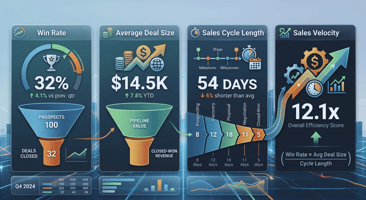
Pipeline velocity is one of the most measurable — and most misdiagnosed — metrics in B2B SaaS...
How B2B Buyers Are Using ChatGPT and Perplexity to Vet a Fractional RevOps Partner
Seventeen sessions. Two conversions. An 11.76% conversion rate — against a 1.25% site average.
That's what ChatGPT, Claude, and Perplexity referrals looked like on this site over a recent 28-day window. Small volume, but the highest-intent traffic this site gets, by a wide margin. Google organic converts at 4.65%. Direct traffic converts at 2.9%. AI assistants are sending fewer people, and nearly all of them are the right people.
This isn't a fluke. It's a preview of how B2B buying research is changing — and most RevOps and marketing leaders haven't adjusted for it yet.
Why Buyers Are Asking AI Assistants Instead of Googling
A CRO evaluating fractional RevOps support used to start with a Google search, click through five blue links, and piece together an opinion from whichever homepage had the best copy.
Now a growing share of that same buyer starts by typing something like "who should I hire for fractional RevOps at a Series B SaaS company" into ChatGPT or Perplexity — and gets a synthesized answer, with sources, in one shot. By the time they land on your site, they're not browsing anymore. They're verifying. That's exactly the pattern in the numbers above: fewer visits, sharper intent, much higher conversion.
The buyers who click through from an AI answer have already been pre-qualified by the assistant's own summary of what you do and who you're for. They're not comparison shopping five tabs deep. They came to confirm what they already half-believe.
What AI Assistants Actually Pull From
AI assistants don't rank pages the way Google does. They synthesize answers from content that's structured, specific, and easy to extract a clean claim from. In practice, that means they favor:
- Named frameworks and methodologies — "the Three-Clock Problem," "the four pipeline velocity levers" — over generic advice, because a named concept is something the assistant can cite and attribute cleanly.
- Specific numbers with sources — "76% of organizations have less than half their CRM data accurate (Validity, 2025)" is quotable. "Data quality is often poor" is not.
- Direct question-and-answer structure — FAQ sections, clearly headed subsections, and content that answers "what is X" or "how do you fix X" in the first sentence, not the fifth paragraph.
- Content that isn't gated — an assistant can't cite what it can't read. Your best proof points can't live exclusively behind a form.
This is the same content that ranks well in traditional SEO, for the most part — but AI assistants are less forgiving of vague, unstructured, marketing-voice copy that takes three paragraphs to say something concrete.
Not sure where your content shows up in AI-assisted buyer research?
Run the free RevOps Readiness Assessment and get a scorecard in under 3 minutes.
A Practical Checklist for Showing Up Well
If you want your site to be a source AI assistants actually cite, not just crawl:
- Name your frameworks. If you have a proprietary way of solving a problem, give it a name and a clear definition. Assistants attribute claims to named concepts far more readily than to unlabeled advice.
- Lead with the answer, not the setup. Put the direct answer to the implied question in the first sentence of a section. Save the narrative buildup for after.
- Cite your own numbers, with sources. Benchmarks, percentages, and named studies are exactly what gets pulled into a synthesized answer.
- Add FAQ sections to high-intent pages. Not as an SEO afterthought — as literal answers to the questions a buyer would type into ChatGPT.
- Keep your best proof ungated. A case study or benchmark that only exists behind a form is invisible to an assistant summarizing your site for someone else.
- Check what the assistants are already saying about you. Ask ChatGPT and Perplexity directly what they know about your firm and your category — the gaps in their answer are your content gaps.
The Bigger Point
This isn't a new SEO fad to chase. It's a small, early signal of a real shift: some meaningful share of your best-fit buyers are outsourcing part of their vendor research to an AI assistant before they ever talk to you. The sites that get cited well in those conversations get a warmer, more qualified visitor. The sites that don't just don't show up in the conversation at all.
The upside is that the actual work — clear frameworks, real numbers, direct answers — is the same work that makes content better for humans, too. You're not writing for the algorithm. You're finally being forced to write like you actually know what you're talking about.
Frequently Asked Questions
What is GEO (Generative Engine Optimization)?
GEO is the practice of structuring content so AI assistants like ChatGPT, Claude, and Perplexity can accurately extract, cite, and recommend it in response to a user's question — distinct from traditional SEO, which optimizes for search engine ranking algorithms.
Do AI-assistant referrals actually convert better than other channels?
In this site's own data, yes — AI-assistant sessions converted at 11.76%, compared to a 1.25% site-wide average, because visitors arrive already pre-qualified by the assistant's synthesized answer rather than browsing cold.
How do I know what ChatGPT or Perplexity is already saying about my company?
Ask them directly. Query each assistant with the questions a prospective buyer would ask, and compare the answer to what you'd want it to say — the gap is your content roadmap.
Brett Hovanec is a fractional RevOps consultant and founder of On The Fly Ops. He helps PE/Series A–C SaaS companies build revenue infrastructure that actually scales.